
The Federal Safety Net Hiding Inside a Trucking Insurance Policy
Key Takeaways: The MCS-90 endorsement is a federally mandated attachment to motor carrier liability policies requiring insurers to pay injured parties up to federal minimums even when the underlying policy would not respond, with the insurer then seeking reimbursement from the carrier. It is not additional coverage and does not excuse proving fault. Triggering the endorsement is fact-dependent and often litigated, typically requiring the vehicle was engaged in interstate transportation under federal rules. Federal rules under 49 C.F.R. Part 387 condition operating authority on minimum financial responsibility, while Fla. Stat. § 627.7415 sets tiered minimums by vehicle weight. Coverage is frequently layered across primary and excess policies, each with its own endorsement, so early settlement offers may not reflect total available funds. Florida’s comparative fault law under Fla. Stat. § 768.81 generally bars recovery by plaintiffs found more than 50 percent at fault since 2023.
When a commercial truck seriously injures someone in Florida, the question that determines recovery is not just who was negligent, but which insurance policy pays. The MCS-90 endorsement is a federally prescribed attachment to motor carrier liability policies that acts as a backstop: if the carrier’s insurance would not otherwise respond, the insurer may still be required to pay injured parties up to the federal minimum, then seek reimbursement from the carrier. It is not extra coverage and does not replace proving fault, but it can mean the difference between a paper judgment and real compensation.
If you or a loved one was hurt in a collision with a commercial truck in South Florida, attorney Daniel Furmanski at Furmanski Law Group can review the carrier’s policies and endorsements with you. Call 305-900-6657 or reach out to our team to discuss your situation.
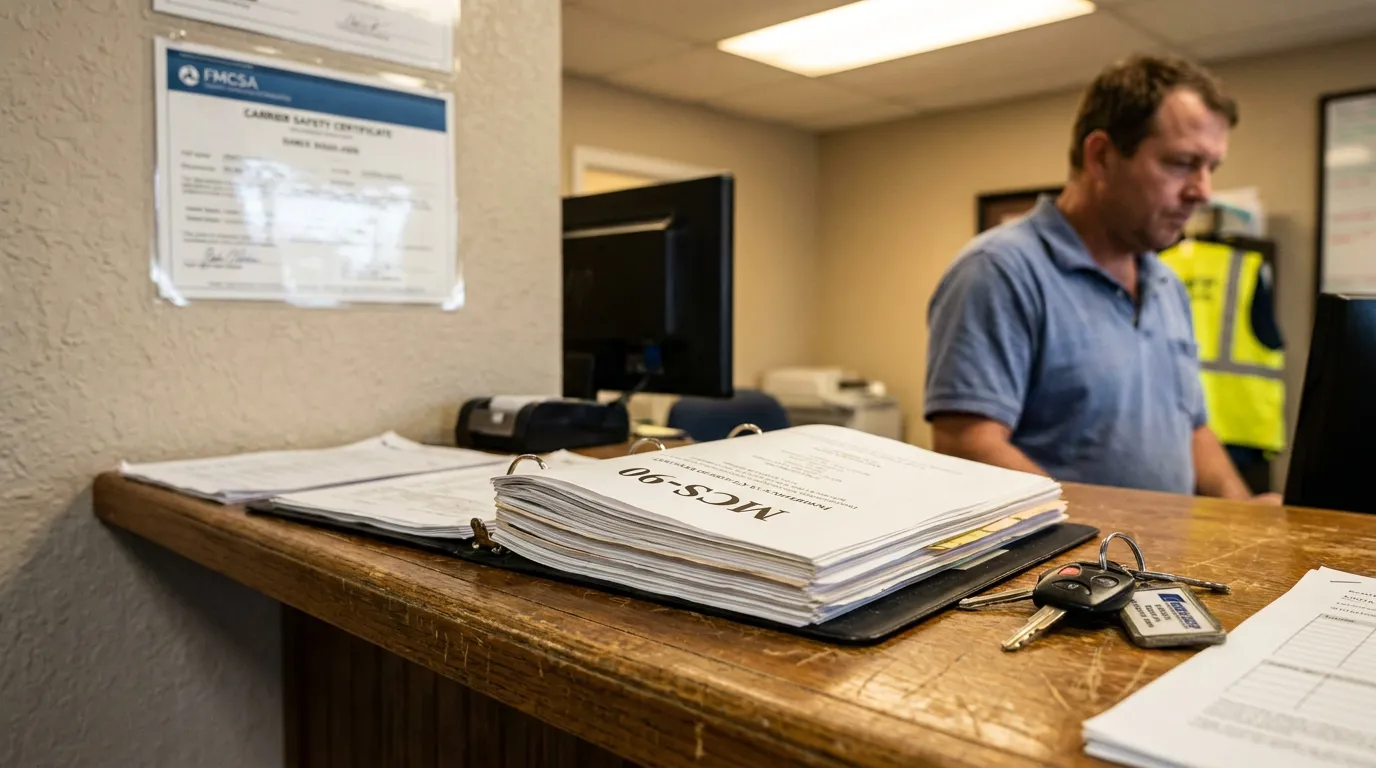
MCS-90 Explained in Plain Language
The MCS-90 is a standardized federal form, not negotiated insurance language. The Federal Motor Carrier Safety Administration prescribes the endorsement under 49 C.F.R. Part 387, and the text may not be changed. That rigidity is intentional, the endorsement exists to protect the public rather than serve the carrier or insurer.
Its function is to prevent coverage disputes from leaving injured people with nothing. If an insurer would deny payment because of a policy condition, exclusion, or carrier breach, the endorsement may still obligate payment to satisfy a final judgment for public liability up to the stated limit. The insurer is then generally entitled to reimbursement from the motor carrier. Whether the endorsement applies in a specific crash is fact-dependent and often litigated; courts examine whether the vehicle was engaged in interstate transportation of property covered by Part 387.
Why FMCSA Insurance Requirements Matter to Crash Victims
Federal law conditions a carrier’s operating authority on proving minimum coverage. FMCSA sets insurance obligations under 49 C.F.R. Part 387 and will not grant operating authority until minimum financial responsibility levels are on file. Those minimums vary by operation, higher limits apply to hazardous materials than general freight. For injured parties, this means documented, verifiable insurance exists behind interstate carriers, even when the driver or company is evasive.
Florida law expressly ties commercial vehicles into that federal framework. Under Fla. Stat. § 627.7415(4), commercial motor vehicles subject to DOT regulations under 49 C.F.R. part 387 must be insured at minimum levels established by federal regulations.
Florida’s Tiered Minimums by Vehicle Weight
Florida sets its own combined liability floors based on truck weight. The Florida commercial vehicle insurance statute establishes tiered minimum combined bodily injury and property damage limits.
| Gross Vehicle Weight | Minimum Combined Liability Coverage |
|---|---|
| 26,000 to under 35,000 lbs | $50,000 per occurrence |
| 35,000 to under 44,000 lbs | $100,000 per occurrence |
| 44,000 lbs or more | $300,000 per occurrence |
These figures from Fla. Stat. § 627.7415 are floors rather than caps and should be verified against current law.
How the MCS-90 Endorsement Truck Accident Analysis Actually Unfolds
Identifying the endorsement is an early investigative step. In serious commercial truck cases, counsel typically requests the full policy, all endorsements, declarations pages, excess or umbrella layers, alongside driver qualification files, logs, maintenance records, and DOT inspection reports. The endorsement may sit several pages deep in a policy that adjusters have no incentive to produce quickly.
Coverage is often layered rather than sitting in one policy. FMCSA guidance explains that carriers may aggregate coverage by purchasing insurance in layers, with each layer consisting of a separate policy and endorsement. Catastrophic injury claims may involve several insurers with different lawyers and incentives.
Each layer carries its own endorsement. FMCSA’s example describes a carrier meeting a $5 million requirement through a $1 million primary policy plus $1 million and $3 million excess policies, each with a separate endorsement. Understanding how carriers aggregate coverage explains why early settlement offers from one insurer may not reflect total available funds.
💡 Pro Tip: Ask early whether the truck was operating in interstate commerce and what commodity it was hauling. Hazardous materials and certain cargo classes trigger higher federal minimums, which can change the realistic scope of a claim.
Common Obstacles Injured Claimants Encounter
Even with a federal endorsement in the file, recovery is rarely simple. Insurers and defense counsel routinely contest whether the endorsement is triggered. Recurring issues include:
- Whether the trip was interstate or purely intrastate at the moment of crash
- Arguments that the underlying policy already covers the loss, making the endorsement irrelevant
- Whether a final judgment is required before the endorsement obligation matures
- Multiple carriers, brokers, shippers, and lessors pointing fault at one another
- Reimbursement clauses that make the carrier, not the insurer, the ultimate payer
These obstacles take time and documentation to overcome. Preserving evidence quickly matters, especially electronic logging data and maintenance records that can be overwritten or lost. Our guide on the steps after a collision walks through practical starting points.
Florida Financial Responsibility Rules Behind Every Crash Claim
State law imposes its own baseline that the federal endorsement supplements. Florida’s Financial Responsibility Law under Chapter 324 requires at-fault owners or drivers to have had liability coverage meeting statutory requirements in effect at the time of the crash, or face suspension consequences.
Florida’s mandatory minimums for standard registered passenger vehicles are strikingly modest by comparison. Florida does not require bodily injury liability coverage for most ordinary passenger vehicles at registration; the state mandates only $10,000 in Personal Injury Protection and $10,000 in Property Damage Liability. Bodily injury liability minimums of $10,000 per person and $20,000 per crash arise under Florida’s Financial Responsibility Law (Chapter 324) after an at-fault crash or certain convictions. Set against federal minimums for motor carriers, the contrast shows why identifying commercial policies and endorsements matters enormously in catastrophic cases.
There is also a judgment-enforcement path built into Florida law. Under Fla. Stat. § 324.121, the department may suspend driving privileges of persons against whom final judgments remain unsatisfied.
Comparative Fault and What It Means for Truck Crash Compensation
Florida apportions damages by percentage of fault. Under Fla. Stat. § 768.81(3), courts enter judgment against each party based on that party’s percentage of fault, not on joint and several liability. In multi-defendant trucking cases, that allocation meaningfully shapes what any one insurer ultimately pays.
The statute’s reach is deliberately broad. Fla. Stat. § 768.81(1)(c) defines negligence actions to include civil actions for damages based upon negligence, strict liability, products liability, professional malpractice, or breach of warranty. Truck cases involving defective components or poorly maintained trailers fall within this apportionment framework.
Percentage allocation directly reduces what a plaintiff recovers. Under Florida’s modified comparative negligence rule in § 768.81(6), damages are reduced in proportion to the plaintiff’s share of fault. A plaintiff found forty percent at fault recovers sixty percent of proven damages, but a plaintiff found more than fifty percent at fault generally recovers nothing. This rule applies to most negligence actions filed after the March 2023 amendment, excluding medical negligence actions.
💡 Pro Tip: Avoid giving a recorded statement to a trucking insurer before you understand the comparative fault issues in your case. Casual phrasing about speed or distance can later be used to argue a larger share of fault against you.
Working With a Florida Truck Accident Lawyer on Coverage Questions
Coverage investigation is a distinct skill set from proving negligence, and both are usually necessary. Daniel Furmanski brings personal injury background and prior agency-side experience to these cases, handling matters personally rather than passing them down. Clients researching complex commercial truck insurance Florida questions often find the coverage picture only becomes clear after formal discovery.
Outcomes depend on specific facts, applicable policies, and procedural posture. Nothing here is a prediction about any particular claim.
Frequently Asked Questions
1. Does an MCS-90 endorsement increase the money available in my claim?
Not exactly. It functions as a guarantee of payment to the public up to a federal minimum when other coverage fails, with the insurer typically entitled to reimbursement from the carrier afterward. Whether it adds practical value depends on policy language, the applicable federal minimum, and the facts.
2. Do all commercial trucks in Florida carry this endorsement?
No. It is tied to federal financial responsibility rules for carriers transporting property in interstate commerce under 49 C.F.R. Part 387. Purely intrastate operations may be governed by Florida requirements such as Fla. Stat. § 627.7415.
3. Can there be more than one MCS-90 endorsement for a single truck?
Yes, in layered arrangements. FMCSA guidance indicates each separate policy in an aggregated structure carries its own endorsement, so carriers meeting high requirements through primary and excess policies may have several.
4. Do I need a final judgment before the endorsement applies?
This issue is fact-dependent and frequently disputed. The endorsement’s text speaks in terms of final judgments, and many courts have treated a judgment as a prerequisite while others have analyzed the question differently. It should be evaluated case by case with counsel.
5. How does my own share of fault affect recovery?
Under Fla. Stat. § 768.81, damages are apportioned by each party’s percentage of fault. Partial fault reduces recoverable damages proportionally, and under current modified comparative negligence rules a plaintiff found more than fifty percent at fault is generally barred from recovery.
Bringing the Pieces Together After a Serious Truck Crash
The MCS-90 endorsement is one part of a larger financial responsibility structure spanning federal regulation under 49 C.F.R. Part 387, Florida’s commercial coverage tiers under Fla. Stat. § 627.7415, and the state’s Financial Responsibility Law in Chapter 324. Layered policies, disputed coverage triggers, and comparative fault under Fla. Stat. § 768.81 all influence what an injured person may ultimately recover. Because these determinations turn on documents rarely produced voluntarily, early and thorough investigation matters in trucking cases.
If a commercial truck crash has upended your life or your family’s, Furmanski Law Group is ready to listen and explain your options. Call us today for a free consultation at 305-900-6657, or schedule your case review to get started.