
Understanding the Insurance Floor Behind Every Interstate Truck on Florida Roads
Key Takeaways: The $750,000 MCS-90 endorsement represents the federal minimum financial responsibility most for-hire interstate carriers hauling nonhazardous property in vehicles rated 10,001 pounds or more must maintain under 49 C.F.R. § 387.9. The MCS-90 is not a policy but a DOT-prescribed endorsement obligating an insurer to pay final judgments arising from negligent operation, maintenance, or use of motor vehicles subject to the regulations, even when the specific vehicle wasn’t listed on the policy. The insurer may then seek reimbursement from the carrier. Carriers may also satisfy requirements through an MCS-82 surety bond or approved self-insurance. Minimums rise to $1,000,000 or $5,000,000 depending on cargo. Critically, this floor is not a cap on recovery. Damages are measured by proven harm and may be reached through higher primary limits, excess layers, or claims against shippers, brokers, maintenance contractors, and other parties.
The $750,000 figure attached to an MCS-90 endorsement is the federal baseline minimum for most interstate for-hire trucking companies. Under 49 C.F.R. § 387.9, for-hire carriers hauling nonhazardous property in interstate commerce with a gross vehicle weight rating of 10,001 pounds or more must maintain at least $750,000 in public liability coverage. That number is a floor, not a ceiling. Understanding this distinction matters when a semi-truck crash leaves a South Florida family facing surgeries, lost income, and long-term care needs.
If you or someone you love was hurt in a collision with a commercial truck, Furmanski Law Group can help you understand how federal coverage rules may affect your claim. Call 305-900-6657 to speak with attorney Daniel Furmanski directly, or contact us now to request a free consultation.
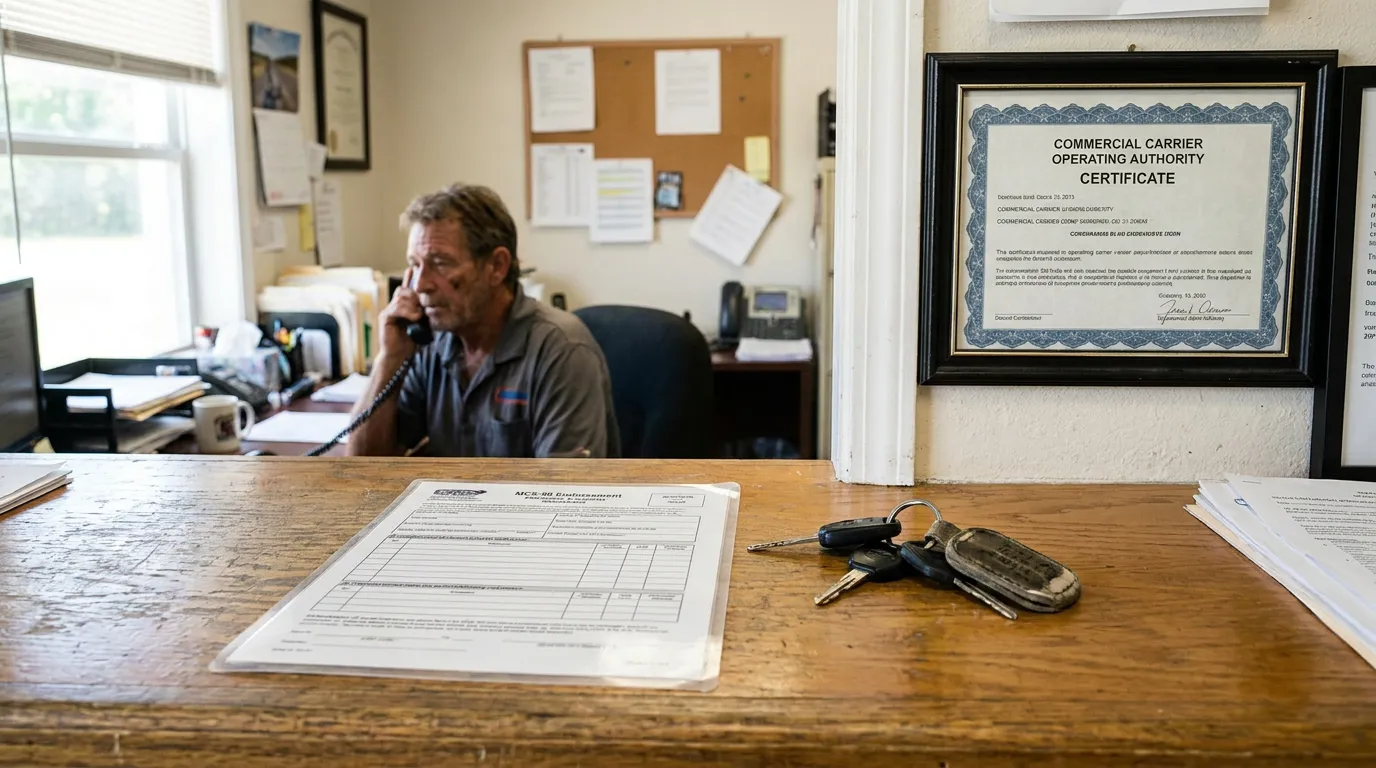
What the MCS-90 Endorsement Actually Does
The MCS-90 is a Department of Transportation-prescribed form attached to a motor carrier’s liability insurance policy to certify that coverage meets required federal minimums. It is not a standalone insurance policy. Instead, it functions as a public safety net, creating an obligation to pay final judgments resulting from negligence in the operation, maintenance, or use of motor vehicles subject to the financial responsibility requirements, even when the specific vehicle involved was not covered under the underlying policy. The carrier must reimburse the insurer for payments the insurer would not have been obligated to make under the policy’s own terms.
This makes the endorsement significant for injured people. Trucking companies and insurers often argue that a particular tractor, trailer, or driver fell outside the policy’s declarations. The endorsement prevents an injured person from being left with an uncollectible judgment because of an internal coverage dispute.
Courts have addressed situations where the endorsement was not physically attached to the policy. Some decisions have imputed the endorsement’s terms as a matter of law, though authority generally treats it as a suretyship of last resort applying only when no other coverage is available or when available coverage falls below the federal minimum.
Three Ways Carriers Satisfy the Requirement
Federal law does not require every carrier to use an MCS-90. A motor carrier may satisfy its financial responsibility obligation in one of three ways:
- An MCS-90 endorsement attached to a liability insurance policy
- An MCS-82 surety bond
- Qualification as an approved self-insurer
The vast majority use the MCS-90 endorsement. Self-insured carriers are often large national fleets with far deeper resources, and identifying which structure applies early can shape claim strategy.
Why $750,000 Is Only the Starting Tier
The $750,000 amount represents one tier in a graduated schedule, not a universal number. The schedule in 49 C.F.R. § 387.9 raises the required minimum depending on what the truck is carrying and its size.
| Type of Operation | Minimum Financial Responsibility |
|---|---|
| For-hire nonhazardous property, GVWR 10,001 lbs or more | $750,000 |
| Oil and certain bulk hazardous materials, GVWR 10,001 lbs or more | $1,000,000 |
| Explosives, poison gas, radioactive materials, and certain other hazardous materials | $5,000,000 |
| For-hire or private, GVWR under 10,001 lbs, transporting Division 1.1, 1.2, or 1.3 materials, Division 2.3 Hazard Zone A, Division 6.1 Packing Group I Hazard Zone A, or highway route controlled quantities of a Class 7 material | $5,000,000 |
Vehicles under 10,001 pounds carrying only nonhazardous property generally fall outside the Part 387 public liability schedule. Household goods carriers operating vehicles rated at 10,001 pounds or more fall under the same $750,000 bodily injury and property damage minimum and must carry cargo insurance of at least $5,000 per vehicle and $10,000 per occurrence under 49 C.F.R. § 387.303. These distinctions are laid out in the agency’s insurance filing requirements chart.
💡 Pro Tip: The cargo a truck was carrying at the time of a crash can change the applicable minimum from $750,000 to $5,000,000. Bills of lading, shipping manifests, and hazmat placards photographed at the scene can be valuable evidence.
How Carriers Prove the Coverage Exists
Proof of financial responsibility is filed with the FMCSA using specific forms. Property carriers meeting the $750,000 threshold generally file a BMC-91 or BMC-91X for insurance, or a BMC-82 surety bond, while household goods carriers must also file a BMC-34 or BMC-83 for cargo coverage. Under 49 C.F.R. § 387.7, no motor carrier may operate until required minimum levels of financial responsibility are in effect.
For injured claimants, these filings confirm which insurer is on the risk, whether coverage lapsed, and whether the carrier’s registration status matched its actual operations.
The $750,000 Federal Minimum Is Not a Limit on Your Recovery
The $750,000 federal minimum does not cap compensation. It defines what a carrier must be financially prepared to pay, not what a jury may award or what a claim is worth. Damages in Florida are measured by actual harm proven, including medical expenses, future care, lost earning capacity, disability, and pain and suffering.
Catastrophic truck crashes routinely produce damages exceeding the interstate carrier insurance floor. When that happens, the analysis shifts to whether additional sources of recovery exist. Many motor carriers purchase primary policies well above the federal minimum, and excess or umbrella layers are common. Shippers, brokers, maintenance contractors, trailer owners, and staffing companies may also carry their own coverage depending on the facts.
This is why a thorough multi-party investigation matters. Driver qualification files, hours-of-service records, electronic logging data, maintenance histories, and dispatch communications often reveal responsible parties beyond the driver alone. A skilled mcs-90 endorsement lawyer will pursue those avenues rather than accepting the first policy an adjuster discloses.
Where Florida Law Enters the Picture
Federal financial responsibility rules govern the trucking company’s coverage obligations, while Florida law generally governs the underlying negligence claim. The federal regulations, including those addressed in the Federal Register guidance on registration and financial responsibility applicability, define minimum coverage and registration duties for interstate operations. Florida negligence law determines duty, breach, causation, and damages.
Purely intrastate Florida trucking operations may be subject to different requirements than interstate carriers.
Practical Steps After a Commercial Truck Collision
What you do in the first weeks after a crash can meaningfully affect how coverage questions play out later. Evidence in trucking cases is often electronic, controlled by the carrier, and subject to routine deletion under federal record retention periods.
- Photograph the tractor, trailer, USDOT number, and any placards if it is safe to do so
- Seek medical evaluation promptly and follow through with treatment
- Save all correspondence from any insurer, without giving a recorded statement first
- Keep a written record of symptoms, missed work, and out-of-pocket costs
It helps to review a practical checklist of steps to take after an accident before speaking with any adjuster. Insurers for corporate carriers often move quickly, sometimes sending investigators to the scene within hours.
💡 Pro Tip: Preservation letters requesting that a carrier retain electronic logging device data, dashcam footage, and maintenance records are frequently sent early in trucking claims. The sooner that request goes out, the better the odds that data still exists.
Reading a Carrier’s Coverage Structure Realistically
Discovering that a truck carried only the minimum coverage does not mean a case is over. It means the investigation needs to widen. Corporate structuring is common in the trucking industry, where a small carrier may operate under contract with a larger logistics company, lease equipment from a separate entity, and employ drivers through a third staffing firm.
Each relationship can create an independent path to recovery. Vicarious liability, negligent hiring, negligent maintenance, and negligent entrustment theories may apply depending on evidence, and federal leasing regulations can affect who is treated as the responsible motor carrier.
Attorney Daniel Furmanski brings a strong personal injury background and prior agency-side experience to these questions, which means he has seen how insurers evaluate and defend commercial claims from the inside. As the sole attorney at the firm, he handles cases personally rather than passing them down a chain.
Frequently Asked Questions
1. Does the $750,000 MCS-90 endorsement amount limit what I can recover?
No. That figure sets the minimum coverage an interstate carrier must maintain under 49 C.F.R. § 387.9. Your damages are determined by evidence, and recovery may come from higher primary limits, excess policies, the carrier’s assets, or other liable parties.
2. What if the truck that hit me was not listed on the insurance policy?
The MCS-90 was designed for that scenario. It creates an obligation to pay final judgments arising from negligent operation, maintenance, or use of motor vehicles even where the vehicle is not identified in the policy. Many courts treat it as last-resort protection applying only when no other insurance is available and only after judgment has been entered.
3. Do these federal minimums apply to trucks that only operate within Florida?
The federal minimums in Part 387 apply primarily to interstate and foreign commerce operations, with limited exceptions for intrastate transportation of certain hazardous materials. Intrastate-only carriers are governed by state requirements.
4. How can I find out what insurance a trucking company carries?
Carriers file proof of coverage with the FMCSA using forms such as the BMC-91, BMC-91X, or BMC-82. Those filings show the federally required minimum rather than the carrier’s total coverage, so formal discovery is typically needed to identify all insurers and applicable limits.
5. How long do I have to bring a truck accident claim in Florida?
Florida sets deadlines by statute that vary based on the type of claim. For most negligence claims accruing after March 2023 tort reform, the period is two years, but earlier claims and claims against government entities follow different rules and notice requirements, so specific dates should be confirmed with an attorney promptly.
Putting the Numbers in Perspective
The $750,000 federal minimum behind an MCS-90 endorsement is best understood as a regulatory floor built to protect the public under 49 C.F.R. § 387.9. It tells you what a carrier had to have, not what your claim is worth. Real recovery in a catastrophic truck crash depends on identifying every responsible party, preserving federally required records, and proving the full scope of present and future losses.
If a commercial truck crash has upended your family’s life in Miami or anywhere in South Florida, Furmanski Law Group is ready to listen. Call 305-900-6657 or contact us now for a free consultation.